
นับต่อจากนี้ เราคือ Elev8
เราไม่ได้เป็นแค่โบรกเกอร์ แต่เป็นระบบนิเวศการเทรดครบวงจร ทุกสิ่งที่คุณต้องการในการวิเคราะห์ เทรด และเติบโตอยู่ในที่เดียว พร้อมยกระดับการเทรดของคุณหรือยัง?
เราไม่ได้เป็นแค่โบรกเกอร์ แต่เป็นระบบนิเวศการเทรดครบวงจร ทุกสิ่งที่คุณต้องการในการวิเคราะห์ เทรด และเติบโตอยู่ในที่เดียว พร้อมยกระดับการเทรดของคุณหรือยัง?
The Australian Dollar (AUD) extends its winning streak for the third successive day on Thursday, following the release of domestic labor market data. The AUD/USD pair also gained support as the US Dollar (USD) depreciates amid rising odds of further rate cuts by the US Federal Reserve (Fed).
Australia’s Employment Change arrived at 24.5K in July from 1K in June (revised from 2K), against the consensus forecast of 25K. Meanwhile, the Unemployment Rate fell to 4.2%, as expected, from 4.3% in June.
US Treasury Secretary Scott Bessent said in an interview on Wednesday that short-term Fed interest rates should be 1.5-1.75% lower than the current benchmark rate at an effective 4.33%. Bessent added that there is a good chance that the central bank could opt for a 50 basis point rate cut in September.
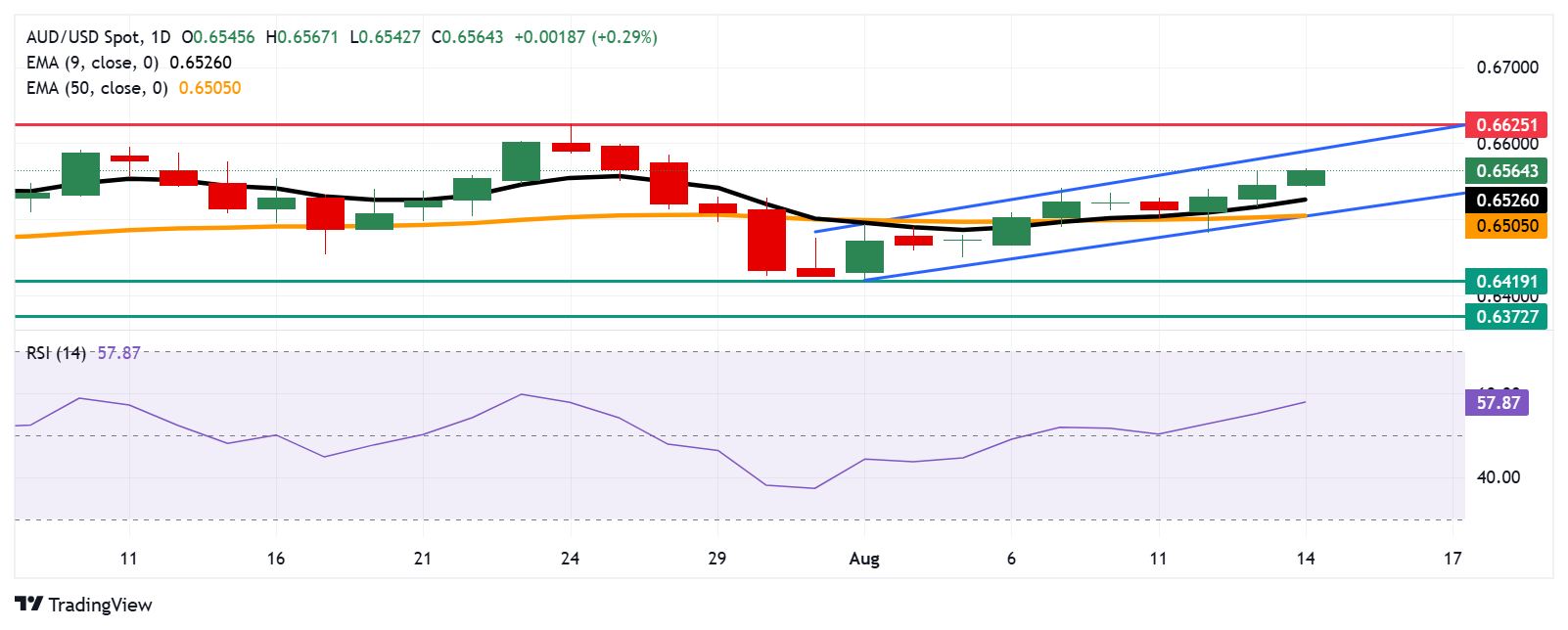
The AUD/USD pair is trading around 0.6570 on Thursday. Technical analysis on the daily chart suggests a persistent bullish bias as the pair moves upwards within the ascending channel pattern. The pair remains above the nine-day Exponential Moving Average (EMA), signaling that short-term momentum is strengthening. Moreover, the 14-day Relative Strength Index (RSI) has moved above the 50 level, confirming that market bias is bullish.
The AUD/USD pair may target the upper boundary of the ascending channel around 0.6590. A break above the channel could reinforce the bullish bias and support the pair to explore the area around the psychological level of 0.6600, followed by the nine-month high at 0.6625, which was recorded on July 24.
On the downside, the AUD/USD pair could test the nine-day EMA of 0.6526, followed by the 50-day EMA at 0.6505 and the ascending channel’s lower boundary around 0.6500. A successful break below this crucial support zone would dampen the short- and medium-term price momentum and prompt the pair to test the two-month low of 0.6419, recorded on August 1, followed by a three-month low at 0.6372, recorded on June 23.
The table below shows the percentage change of Australian Dollar (AUD) against listed major currencies today. Australian Dollar was the strongest against the US Dollar.
| USD | EUR | GBP | JPY | CAD | AUD | NZD | CHF | |
|---|---|---|---|---|---|---|---|---|
| USD | -0.05% | -0.12% | -0.64% | -0.09% | -0.33% | -0.20% | -0.05% | |
| EUR | 0.05% | -0.03% | -0.58% | -0.05% | -0.27% | -0.16% | -0.00% | |
| GBP | 0.12% | 0.03% | -0.56% | 0.09% | -0.18% | -0.02% | 0.13% | |
| JPY | 0.64% | 0.58% | 0.56% | 0.55% | 0.30% | 0.32% | 0.54% | |
| CAD | 0.09% | 0.05% | -0.09% | -0.55% | -0.20% | -0.11% | 0.05% | |
| AUD | 0.33% | 0.27% | 0.18% | -0.30% | 0.20% | 0.16% | 0.21% | |
| NZD | 0.20% | 0.16% | 0.02% | -0.32% | 0.11% | -0.16% | 0.11% | |
| CHF | 0.05% | 0.00% | -0.13% | -0.54% | -0.05% | -0.21% | -0.11% |
The heat map shows percentage changes of major currencies against each other. The base currency is picked from the left column, while the quote currency is picked from the top row. For example, if you pick the Australian Dollar from the left column and move along the horizontal line to the US Dollar, the percentage change displayed in the box will represent AUD (base)/USD (quote).
The Employment Change released by the Australian Bureau of Statistics is a measure of the change in the number of employed people in Australia. The statistic is adjusted to remove the influence of seasonal trends. Generally speaking, a rise in Employment Change has positive implications for consumer spending, stimulates economic growth, and is bullish for the Australian Dollar (AUD). A low reading, on the other hand, is seen as bearish.
Read more.Last release: Thu Aug 14, 2025 01:30
Frequency: Monthly
Actual: 24.5K
Consensus: 25K
Previous: 2K
Source: Australian Bureau of Statistics